Apollo 1
What happened on January 27, 1967 — and what it cost to continue
Part of Dare Mighty Things·Apollo
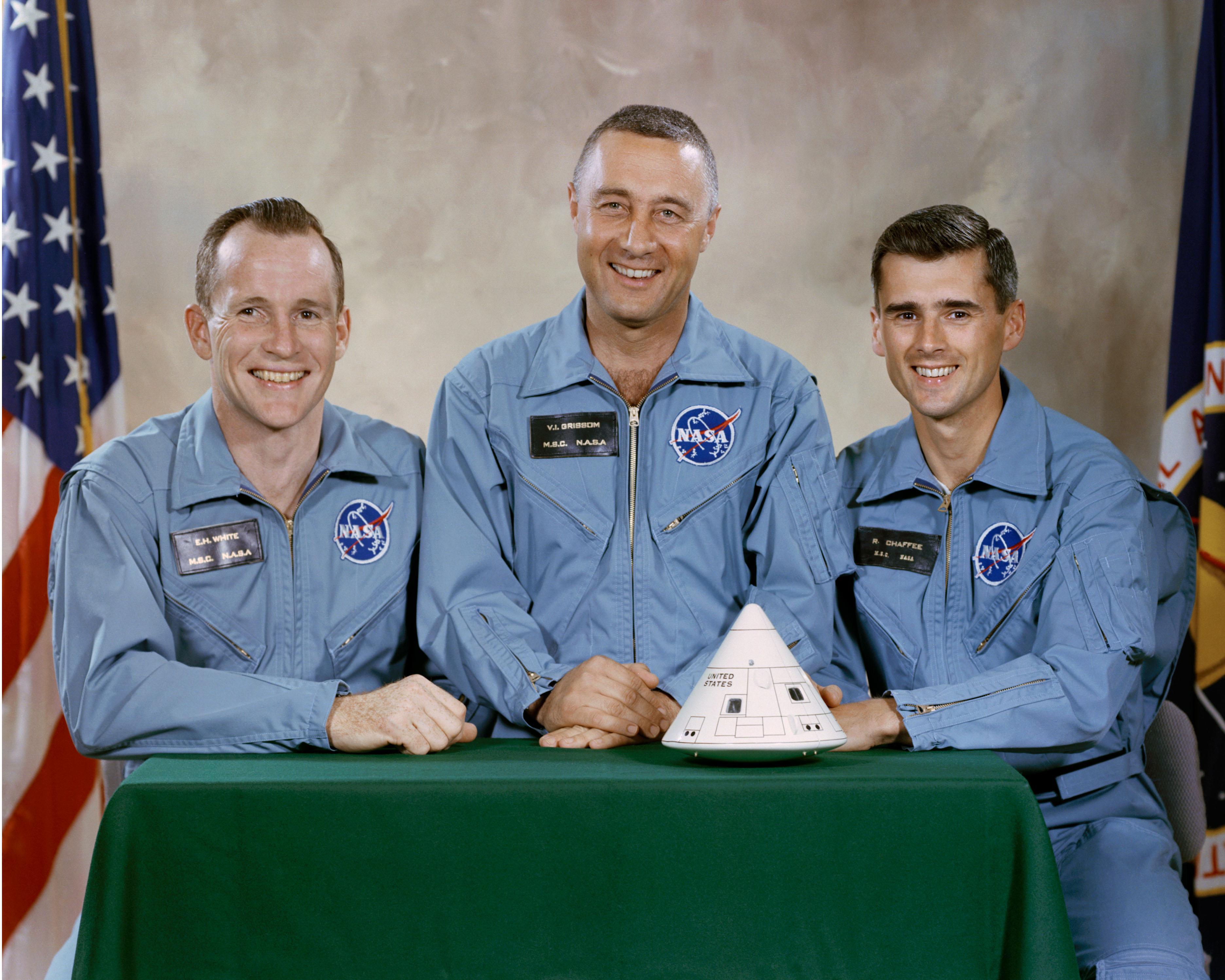
The Fire
Part of the Dare Mighty Things series — Apollo | Estimated read time: 7 minutes
On Monday morning, January 30, 1967, three days after the fire, Gene Kranz walked into a room full of people who couldn't look each other in the eye and told them the truth.
He was NASA's flight director — the man responsible for coordinating everything that happened in Mission Control during a mission. He was 33 years old. He was wearing his characteristic flattop and the vest his wife had made him. He had spent the weekend thinking about what he was going to say to the people in that room, because he knew that what he said in the next few minutes would determine whether the Apollo program continued or collapsed under the weight of what had just happened.
He did not offer comfort. He did not deflect blame. He stood at the front of the room and said the words that nobody wanted to hear.
"Spaceflight will never tolerate carelessness, incapacity, and neglect. Somewhere, somehow, we screwed up. It could have been in design, build, or test. Whatever it was, we should have caught it. We were too gung-ho about the schedule, and we locked out all of the problems we saw each day in our work. Every element of the program was in trouble, and so were we."
He paused. Then he told them what they were going to do about it.
"From this day forward, Flight Control will be known by two words: Tough and Competent. Tough means we are forever accountable for what we do or what we fail to do. We will never again compromise our responsibilities. Competent means we will never take anything for granted. We will never be found short in our knowledge and in our skills. Mission Control will be perfect. When you leave this meeting today, you will go to your office, and the first thing you will do there is to write 'Tough and Competent' on your blackboards. It will never be erased. Each day when you enter the room, these words will remind you of the price paid by Grissom, White, and Chaffee."
The speech became known as the Kranz Dictum. It is still quoted at NASA today, in training rooms and mission briefings, more than half a century later.
But to understand why those words mattered — to understand what Kranz was really saying, and what it cost to say it — you have to go back to the Friday afternoon before.
Three Men
Gus Grissom was 40 years old, a veteran of the Mercury and Gemini programs, the second American to fly in space, and the first to fly twice. He was compact, direct, occasionally blunt, and deeply skeptical of the spacecraft he'd been assigned to fly. He'd been complaining about it for months — bad wiring, poor communication, shoddy quality control by the contractor, North American Aviation. He'd hung a lemon over the simulator's hatch. He'd told NASA engineers, darkly, that he and his crew had decided to go over their heads and pray. He knew the spacecraft wasn't ready. He kept showing up anyway, because that was what Gus Grissom did.
Ed White was 36, the most physically fit astronaut in the corps — a man who ran before dawn and bicycled three miles to work at the Manned Spacecraft Center each morning. He had been the first American to walk in space during Gemini 4, floating free above the Earth with a smile so wide it became one of the defining images of the Space Age. He was, by most accounts, the kind of person who made everyone around him better simply by being present.
Roger Chaffee was 31 and had never flown in space. He was the youngest member of the crew — an engineer's engineer, meticulous and methodical, assigned to manage communications during the flight. He had spent the year before Apollo 1 watching Grissom hang lemons and file complaints, and he had filed his own. He knew what was wrong. He showed up, too.
On January 27, 1967, all three of them were subdued. Their secretary, Lola Morrow, noticed it. She referred to the program, privately, as Project Appalling. The three men crossed the gantry at Launch Complex 34 at Cape Kennedy on a Friday afternoon for what was supposed to be a routine test — a "plugs-out" simulation to verify that the spacecraft could operate on its own internal power, with no fuel loaded, no pyrotechnics armed, no launch vehicle propellant aboard. Nobody was flying anywhere. The test was considered low-risk. It had been done dozens of times before on Mercury and Gemini capsules.
At 1:00 in the afternoon, Grissom, White, and Chaffee climbed in and strapped down.
What Happened
Almost immediately, problems.
Grissom noticed a strange odor in the air circulating through his suit — something like sour buttermilk, he said. Technicians scrambled to take air samples. Nothing was found. The countdown resumed. Then communications began failing. The link between the crew, the control room, and the launch blockhouse was so unreliable that Grissom, frustrated after hours of it, finally said: "How are we going to get to the Moon if we can't talk between two or three buildings?"
By 6:30 in the evening, the test had been dragging for five and a half hours. The crew was annoyed. The controllers were tired. The hatch was sealed, and the cabin had been pressurized to 16.7 pounds per square inch — slightly above atmospheric pressure — with pure oxygen. In space, the cabin would operate at much lower pressure, making pure oxygen manageable. On the ground, at full atmospheric pressure, it was an entirely different environment. In pure oxygen at 16.7 psi, nearly anything would burn. The designers had known this. They had done the calculations. They had decided the risk was acceptable.
At 6:31 in the evening, something sparked beneath Grissom's seat — most likely an electrical arc in the wiring that ran under the left side of the cabin near the environmental control system. The spark caught. In the pure-oxygen atmosphere, the fire spread within seconds.
The first transmission came at 6:31:04. It was one word, from Chaffee: "Fire."
Two seconds later: "We've got a fire in the cockpit."
Five seconds after that, a badly garbled transmission, believed to be Chaffee's voice: "We've got a bad fire — let's get out — we're burning up."
Then a cry of pain. Then silence.
Ed White had been reaching for the inner hatch release when the pressure inside the cabin — rising rapidly from the heat — sealed the plug door shut with forces no human could overcome. The hatch opened inward; at sufficient internal pressure, it was physically impossible to open. White couldn't do it in training under ideal conditions in under two minutes. He had seconds.
The pad crew outside fought through heat and toxic smoke for five minutes to get the hatches open. When they finally reached the interior of the capsule, it had been twenty-seven seconds since the fire began.
All three astronauts were gone.
What They Found
The investigation took three months and produced a 3,000-page report. What it found, when read plainly, was not primarily a technical failure. It was a failure of culture.
The fire had three direct causes. First: a pure oxygen atmosphere at higher than atmospheric pressure, in which nearly anything would ignite. Second: an enormous quantity of combustible material inside the cabin — nylon netting, Velcro pads, foam padding, paperwork, wiring insulation — that no one had systematically audited for fire risk. Third: a hatch that was physically impossible to open quickly under the conditions present on January 27, 1967, by design — specifically because NASA had decided, after Grissom's Liberty Bell 7 hatch blew prematurely during splashdown in 1961, that a hatch that could open explosively was more dangerous than a hatch that opened slowly.
Intelligent, capable people had made each of those decisions with good reasons. Each of them, in combination with the others, was catastrophic.
But the report went further than the technical findings. A U.S. Senate inquiry concluded that everyone associated with the spacecraft design and test had simply failed to understand the combined danger of an ignition source, combustible materials, and a pure oxygen atmosphere in a sealed cabin at high pressure. The program had been moving too fast, under too much pressure to meet Kennedy's end-of-decade deadline, and problems that should have stopped the test had been accepted, logged, and worked around.
Grissom had known. His crew had known. They had kept showing up.
The Twenty Months
The Apollo program stopped.
For twenty months, NASA took the spacecraft apart — literally — and put it back together differently. The redesigned Block II command module replaced the pure oxygen ground atmosphere with a safer oxygen-nitrogen mix. Combustible materials were systematically replaced with fire-resistant alternatives. The wiring was rerouted and properly insulated. And the hatch was completely redesigned: a single, unified hatch that opens outward and can be opened by the crew in under ten seconds under normal conditions.
More than 1,400 design changes were made to the spacecraft. Simultaneously, NASA restructured its management and safety review processes — creating new oversight boards, new sign-off requirements, and new protocols designed to surface exactly the kind of compounding risks that the investigation had identified.
It was during those twenty months that Kranz's words on the Monday morning after the fire did their real work. He had told his team that they were accountable — not for what had failed in the past, but for what they would build next. Not to mourn, but to make it right. The phrase "tough and competent" went on blackboards in offices across Johnson Space Center and Cape Kennedy and stayed there.
When Apollo 7 finally flew in October 1968, twenty months after the fire, it was a different spacecraft and a different organization. The crew — Wally Schirra, Donn Eisele, and Walt Cunningham — flew eleven days in low Earth orbit without a major incident. Everything worked. The spacecraft that Grissom had hung a lemon over had become something he might have trusted.
And ten months after that, two men walked on the Moon.
What It Cost
There is a version of history in which Apollo 1 ended the program. NASA had never lost astronauts in space — had never lost astronauts at all — and the political will to continue — to keep sending people into capsules atop rockets — was not guaranteed. It could have gone the other way.
It didn't, for reasons that are worth sitting with. Grissom, White, and Chaffee had known the risks. They had flagged the problems. They had shown up on a Friday afternoon for a test nobody thought was dangerous, and they had not come back. The people who came in on Monday morning and heard Gene Kranz tell them they were accountable — those people went to their offices and wrote two words on their blackboards, and went back to work.
Not because the grief was finished. Because the work was what the grief demanded.
Some of those who worked on subsequent missions have said privately that they don't believe Apollo 11 could have succeeded without the fire. That the organizational transformation forced by the tragedy — the ruthless reassessment of assumptions, the new culture of accountability, the redesigned spacecraft — was necessary. The program that existed before January 27, 1967, could not have safely landed on the Moon.
That is an uncomfortable belief. It is also, by the evidence, probably true.
Grissom, White, and Chaffee are buried with full military honors — Grissom and Chaffee at Arlington National Cemetery, White at West Point. Pad 34 at Cape Kennedy still stands, officially decommissioned, never demolished. A plaque at its base reads:
"They gave their lives in service to their country in the ongoing exploration of humankind's final frontier. Remember them not for how they died but for those ideals for which they lived."
This article is part of the Dare Mighty Things series — Apollo branch.
[→ Next in Apollo: Earthrise — the improvised gamble that sent humans to the Moon for the first time]
[← Back to Apollo: The Audacity — the full Apollo hub]
[← Back to the main series: Dare Mighty Things — The Story of America's Space Program]
That’s no moonshot. – Hi, I'm Heather Burns. https://heatherburns.tech/2023/09/01/thats-no-moonshot/
Stover, C. W. (2014). The Early History of the United States Space Program. https://core.ac.uk/download/198423935.pdf
Mauffrey, C., & Butler, N. (2014). Current challenges and future perspectives for patient safety in surgery. https://doi.org/10.1186/1754-9493-8-9
The Kranz Dictum | Jorge Arango. https://jarango.com/2019/11/22/the-kranz-dictum/
dsc07467.jpg. http://heroicrelics.org/ksc/lc-34/dsc07467.jpg.html
