Ireland’s Immigration Fight: Housing, the Pact, and a Country Arguing With Itself
The rows on O’Connell Street are loud. The quieter fight is in statute books, IPAS centres, and a housing market that was already broken before the flags came out.
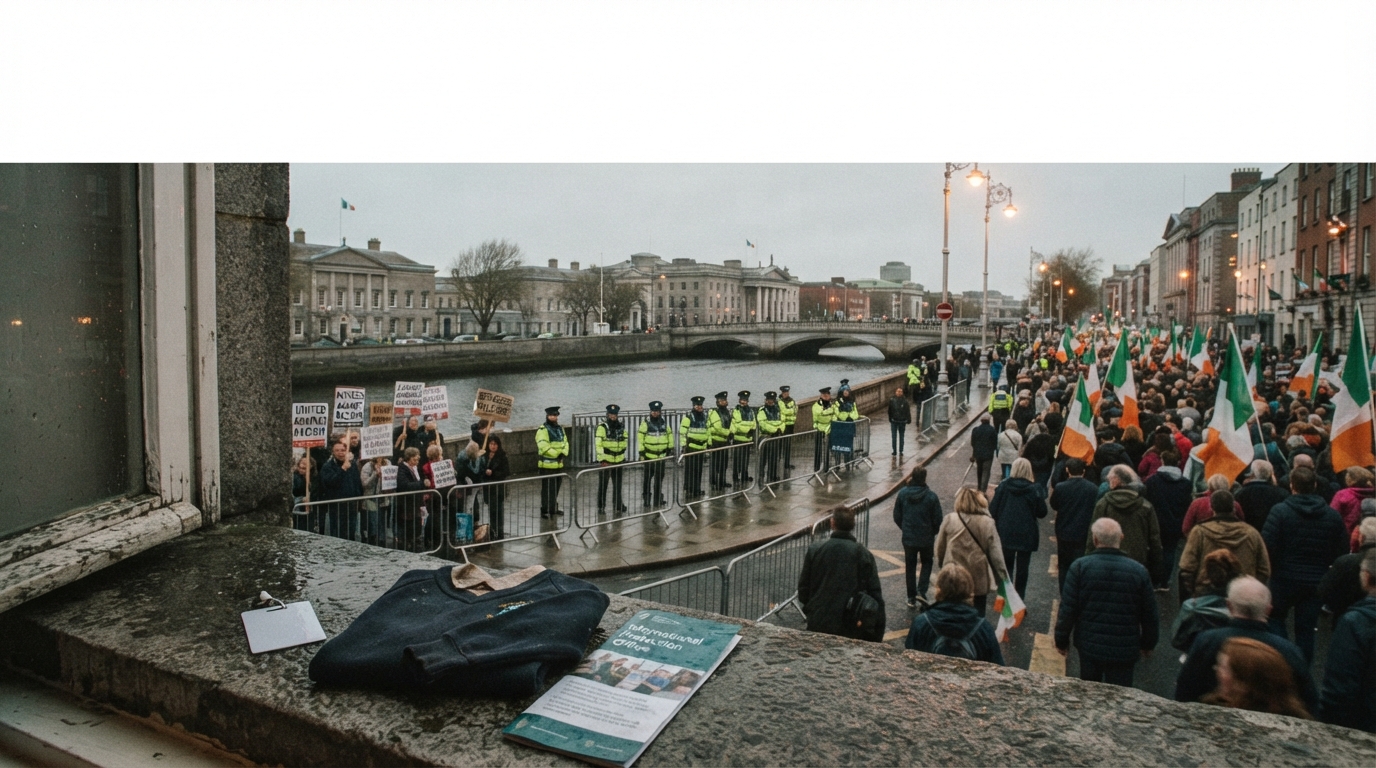
Ireland is having the argument the rest of Western Europe already had. It is having it late, fast, and on an island that ran out of spare rooms years ago.
You can see the loud version any weekend in Dublin. Tricolours packed onto Parnell Square. People shouting “Get them out” and “Ireland is full.” Banners against the EU Migration Pact. Independent councillors on a platform outside the GPO, talking as if the State has already surrendered. A few streets away, or a week later, another crowd answers them: this city belongs to everybody. In June, as the new European rules came into force, hundreds marched against immigration. An anti-racism column that same month put its own turnout near two thousand.
Across the border in Belfast, the temperature was higher. A stabbing charge against a Sudanese man was followed by two nights of riots, bricks, fires, water cannon, immigrant families burned out of their homes, dozens of officers hurt. Politicians north and south called it thuggery. The streets did not empty.
Online, the story grew a second life it had not earned. Mid-September posts claimed two hundred thousand people had marched on the Dáil during a five-day “nationwide shutdown.” Gardaí and the Defence Forces told Reuters that did not happen. The photographs were more than a year old, the anger is real, the crowd count was not. That distinction matters, because the country is already struggling to tell the difference between a genuine crisis and a clip designed to travel.
The protests did not begin this year, they have flickered on and off since late 2022, usually in the same shape, the State announces an IPAS centre in a town that cannot house its own, and the town decides it has been volunteered. Coolock, Citywest, Drogheda. Arson. Petrol bombs thrown at gardaí. A riot after the alleged rape of a child by a centre resident. Another centre set alight with children still upstairs. Ugly nights, and not a complete explanation. Ireland’s housing collapse after the crash never fully healed. Then came Ukrainian temporary protection in 2022. Then a sharp rise in international protection arrivals into a system built for a quieter country. IPAS has held more than thirty thousand people at a time. Irish family homelessness was already a national emergency. Put those two facts in the same paragraph and you have the politics, whether or not you like the people holding the flags.
Dublin has spent 2026 trying to look as if it heard that paragraph.
On June 12 the International Protection Act came into force, the biggest rewrite of Irish asylum law in the history of the State, and Ireland’s version of the EU Migration and Asylum Pact. An accelerated procedure for applicants from countries where recognition rates sit at twenty percent or lower, decisions, appeals and return orders inside three months. A trial of the fast track, run on more than two thousand two hundred claims from places such as Georgia, Malawi, Algeria, Bangladesh and the Western Balkans, produced roughly ninety percent refusals. Deportation orders are up, while actual removals are not. Taoiseach Micheál Martin has said Ireland has “no immediate plans” for EU-style return hubs abroad. Street organisers and Aontú still talk about the pact as an open door and the statute is written as a faster filter. Both descriptions can be true in the same week, which is why neither side trusts the other.
Housing policy is being tightened in the same breath. Lawful and habitual residence are being written into social housing rules. Family reunification sponsors now have to prove they can actually house the people they want to bring. Income thresholds for Irish citizens sponsoring a spouse or child have jumped. Ukrainian supports are being wound down: commercial beds contracted by the State phased out by March 2027, the payment to host families cut back toward four hundred euro and headed for the door, a new Stamp 4 style scheme for those who work and clear a salary floor. Recognised refugees have been told to leave IPAS and find private housing, into the same market that cannot absorb the Irish waiting list. Housing officials warned Justice there would be a homelessness spike. The letters still went out anyway. “Not sustainable,” the minister said. That is the civil service version of “Ireland is full.”
A draft amendment bill landed this month. People who came here to work already talk about packing bags if the rules harden while the rent stays absurd. Last week thousands were naturalised; Indians were the largest group. The country is still taking people in while arguing about the ones already here. That is not hypocrisy so much as a State trying to close a door with one hand and keep an economy running with the other.
Two Irelands are speaking past each other. One says the government lost control of numbers, hotels and towns, and that a culture is not a waiting room. The other says a republic that shipped its children to Boston and Birmingham for a hundred and fifty years does not get to invent amnesia, and that burning a family out of a terrace is not a housing plan. Polling this month found a slim majority still calling immigration a net positive, much slimmer than it used to be. Housing and the cost of living remain the first worry. Immigration has climbed the list because it is where those worries now have a building and a face.
The open border with the North makes every Dublin rule leak. After Belfast, ministers talked about the frontier as an entry route. Reform UK talks about spot checks. Dublin talks about shared responsibility. Nobody has drawn a line that works on both sides of a peace that was bought, in part, by keeping that line soft.
What Ireland is really fighting about is not only who arrives. It is whether a small, rich, housing-poor country can keep a generous asylum brand and a functioning social contract at the same time. The new law speeds the no. The centres still overflow. The marches will be back. The test is not the chant on O’Connell Street. It is whether the next family offered a hotel room in a town with no GPs still believes the State is on their side, whichever family that is.