Master-at-Arms 2nd Class Michael A. Monsoor
U.S. Navy · SEAL Team 3, Delta Platoon
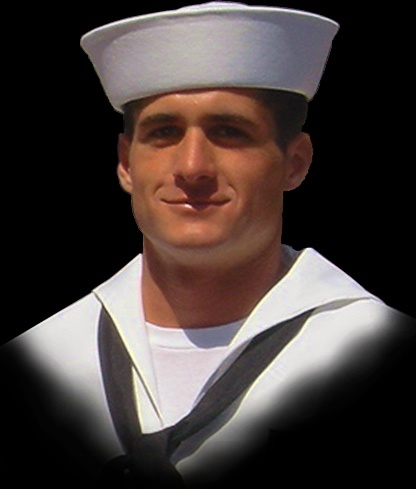
April 5, 1981 — September 29, 2006 · Killed in action, Ramadi
Twenty years ago, on September 29, 2006, on a rooftop in Ramadi, a 25-year-old from Garden Grove had about one second to decide something. He was the only man up there with a clear path to the stairs. He used that second to shout a warning to the men who didn't.
Then he lay down on the grenade.
Michael Anthony Monsoor was born on April 5, 1981, in Long Beach, the third of four children. His father, George, had served in the Marine Corps. His mother, Sally, kept the house running. He grew up with asthma — the kind that makes a boy sit out the games other boys are playing.
He decided to race his brothers and sisters in the family pool instead. Lap after lap, until his lungs gave in and got stronger. His father would later describe him in five words: a young boy with an unbreakable will.
At Garden Grove High he played tight end. He graduated in 1999. He enlisted in the Navy on March 21, 2001, and volunteered for the hardest training the service offers.
And he didn't make it.
He withdrew from BUD/S during the first phase. That is where most versions of this story would quietly skip ahead. We're not going to, because what he did next is the whole measure of him.
He took an assignment as a master-at-arms in Sicily and served there for two years. Then he went back and started over. On September 2, 2004, he graduated with BUD/S class 250 — as one of the top performers in it.
Some men are born able. Michael Monsoor went back.
By April 2006 he was a machine gunner and communicator with Delta Platoon, SEAL Team 3, deployed to Ramadi to train Iraqi soldiers. He carried roughly a hundred pounds of gear through streets where the temperature ran past 100 degrees.
On May 9, 2006, a teammate went down in the open under continuous enemy fire. Monsoor ran out into that street and pulled him back. He was awarded the Silver Star.
Remember that, because of what comes next. What happened in September was not a reflex. It was not luck or bad positioning. It was the second time he made the same choice.
On the morning of September 29, 2006, his platoon fought off four insurgents and expected more. Monsoor, three SEAL snipers and three Iraqi soldiers took up a position on a rooftop. He set his machine gun on an outcropping between two of his teammates.
The official record is unsentimental about why he was standing there: he was the only SEAL with quick access to the escape route.
A grenade came up from below. It struck him in the chest and dropped at his feet.
He yelled "Grenade!" — he warned them first — and went down on top of it.
His two teammates lived. Michael was evacuated immediately and died about thirty minutes later.
His parents named him for St. Michael the Archangel, the one Scripture puts at the head of the armies of heaven. He died on the Feast of St. Michael the Archangel.
That is not a detail a writer would dare invent. It simply happened.
He kept his faith where it costs something to keep it. In Iraq he went to Mass and to confession with the Navy chaplain, Father Paul Halladay. A teammate has said publicly that Michael was the reason he came into the faith himself, back during those two years in Sicily — the assignment Michael took after he failed.
On April 8, 2008, President George W. Bush presented the Medal of Honor to George and Sally Monsoor at the White House.
He was buried at Fort Rosecrans National Cemetery in San Diego, and what happened there has become part of how the Teams remember their own. SEALs lined the route in two columns. As the coffin passed, each man pulled the gold Trident off his own uniform and drove it into the wooden lid.
It went on for nearly half an hour. The President described what was left: "the simple wooden coffin had become a gold-plated memorial to a hero who will never be forgotten."
Today the guided missile destroyer USS Michael Monsoor carries his name across the same ocean he first learned to swim in.
We are starting this page with a man nobody had to nominate, because his name is already carved into a ship and a headstone and a Medal of Honor citation.
But most of them aren't.
Most of the men and women who belong on a page like this are known to a handful of people — a mother, a squad, a small town that still hangs the flag on the right days. That is who this section is actually for.
If you carry a name like that, we want it.
Awarded: Medal of Honor, Silver Star · Buried: Fort Rosecrans National Cemetery, San Diego