Spain’s Immigration Crisis: When the Threshold Gives Way
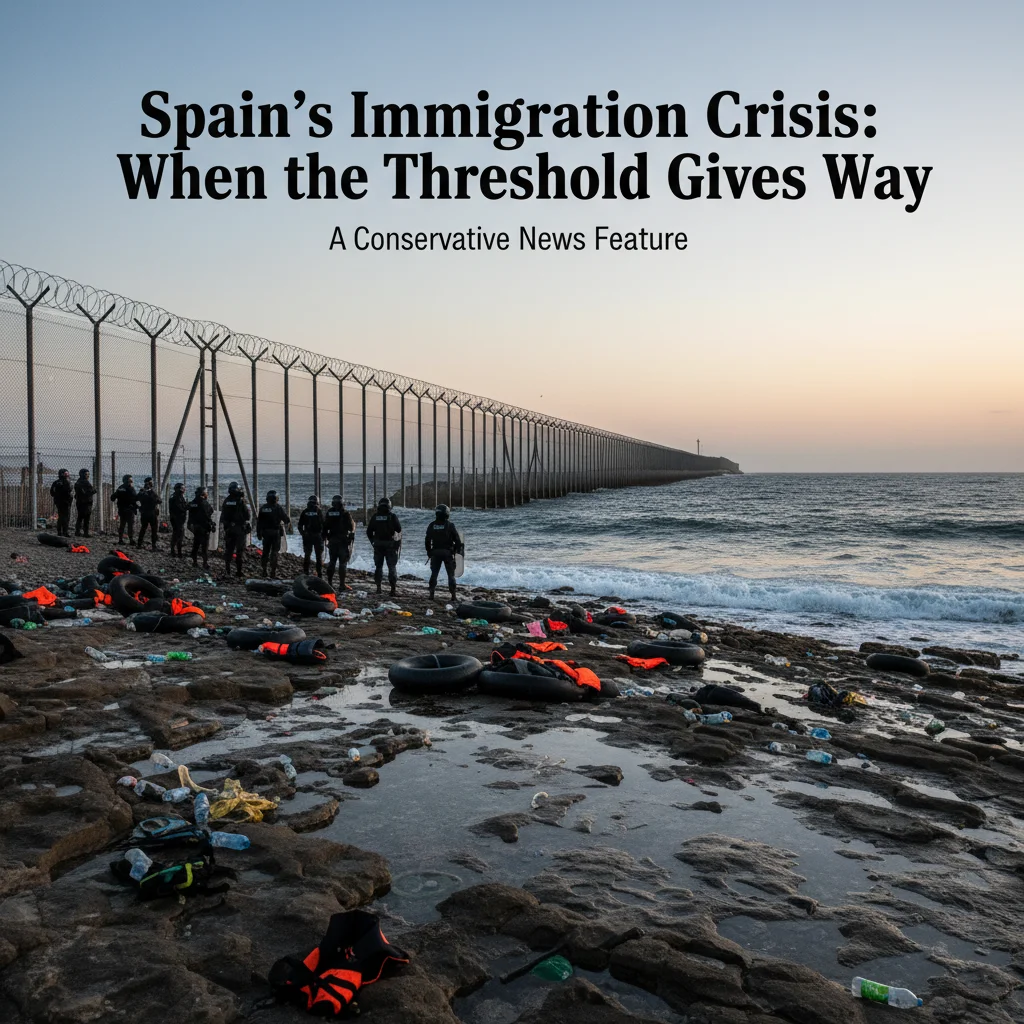
On the last two days of July, a Spanish city of 84,000 people was nearly doubled by a human wave. Between July 30 and 31, tens of thousands of migrants, Spanish officials later put the figure near 70,000, crossed from Morocco into Ceuta, the North African enclave Spain has held for centuries. They swam the breakwaters and rushed the fence. At least 141 people died in the waters and stampedes around Ceuta and the Moroccan town of Fnideq. Within 72 hours, Madrid says more than 90 percent had been sent back. That statistic is true. It is also incomplete.
Weeks later, thousands remain. Reception centers collapsed. Unaccompanied minors cannot be pushed back under Spanish law. Residents marched almost daily. On September 2, tens of thousands of Spaniards filled squares from Madrid to Ceuta itself. The People’s Party called it occupation, while Vox called it invasion. Twenty two European governments warned that Spain’s own policies had become a magnet.
Ceuta was not a bolt from the blue. It was the crack in a larger structure: a country whose foreign-born population has crossed one in five residents, whose sea routes have killed thousands, whose housing stock is hundreds of thousands of units short, and whose Socialist government chose 2026 to regularize more than a million people living in the country illegally. Nations are not hotels. Charity that cannot distinguish the guest from the household is not charity.
A country that no longer replaces itself
As of July 1, 2026, Spain’s National Statistics Institute counted 49.8 million residents. Of those, 10.29 million were born abroad, which is 20.7 percent of the country. Foreign nationals numbered 7.44 million, nearly 15 percent. The gap between those figures is rapid naturalization. Spain granted a record 299,732 citizenships in 2025.
That growth is not organic. Deaths among resident Spanish born mothers have outnumbered births since 2015. Fertility sits among the lowest in Europe. In the second quarter of 2026 the country added 104,178 people while the native born population kept shrinking. The leading arrivals that quarter were Colombian, Venezuelan, and Moroccan.
Prime Minister Pedro Sánchez treats the numbers as an argument. Without immigration, he said this summer, Spain would lose 19 percent of GDP by 2050. Bars would close, classrooms would empty, farms would vanish. Foreign workers already account for roughly a third of hospitality affiliates and more than a quarter of agriculture and construction. After COVID, more than three million people arrived. The government credits that wave with making Spain one of Europe’s fastest growing large economies.
Spanish families feel a different ledger. Funcas and the Bank of Spain put the housing shortage between 700,000 and 750,000 homes. Spain forms far more households each year than it builds dwellings. In fact rents hit records in mid-2026 at about €15 per square meter nationally, more than €23 in Madrid. Overcrowding among private-market renters has climbed above 20 percent. Legalizing more than a million people already competing for the same scarce rooms does not create housing. It converts shadow demand into formal demand and calls the squeeze integration.
The amnesty that doubled itself
In January the Sánchez government opened an extraordinary regularization. Undocumented migrants who could show they had been in Spain at least five months, present before December 31, 2025, and who had no criminal record could apply for a one-year residence and work permit.
By the June 30 deadline, more than 1.17 million had applied. Two thirds were from Latin America. Colombians were the largest single group. After Ceuta, twenty two EU heads of government wrote to Brussels describing the scheme as a potential pull factor. The Commission declined to draw a straight line.
Spain has run six prior amnesties in four decades, including under conservative governments. Each was sold as the last cleanup of a shadow population. Each taught the next cohort that illegal presence, if endured long enough, becomes a credential. The 2026 program is the largest and also the worst timed: it landed in the same year the Supreme Court restricted “hot returns” of migrants intercepted at sea off Ceuta and Melilla, and in the same summer Moroccan social media circulated calls to storm the Ceuta fence.
Two routes, one policy
Spain’s immigration story is not one story. Collapsing them is how both the open borders left and the crudest nativist right lose the plot.
Latin Americans are the plurality of the foreign born population and the majority of the 2026 regularization. Language, Catholic heritage, and a two-year path to citizenship for most Ibero-American nationals make this flow unlike the North African and Sahelian routes. A country can share a language with Caracas and still lack apartments in Valencia.
The other Spain fills the evening news. In 2024, 64,019 people reached Spanish territory irregularly, most by sea. The Canary Islands alone took 46,843. The aid group Caminando Fronteras estimated more than 10,000 deaths on routes toward Spain that year, the large majority on the Atlantic crossing from West Africa, among the deadliest corridors on earth. In 2025 irregular arrivals fell 42.6 percent, to 36,775, and Canary arrivals dropped 62 percent to 17,788. Deaths fell as well; the NGO still counted more than 3,000. As the Canaries cooled, pressure moved. Land entries into Ceuta jumped 39 percent in 2025. In the first half of 2026, before the July avalanche, they had already more than tripled year on year. The Western Mediterranean corridor was the rare European route still rising. When a route closes, another opens. That is the operating principle of the smuggling industry.
The week the map became a crowd
Ceuta is six miles of Spanish soil on the African coast. It has been a flashpoint for years, from fence rushes in 2021, swimming crossings in fog, constant pressure from a neighbor that has never accepted Spanish sovereignty over the plaza. That being said, July was different in scale.
Spanish intelligence had warned Moroccan counterparts the day before. Declassified documents later showed Madrid had flagged WhatsApp groups named for storming the fence and Facebook pages with tens of thousands of followers, timed to a Moroccan royal holiday when security might be distracted. Sánchez later said Morocco’s role needed to be “clarified.” The images, young men in the water, bodies on the rocks, a city suddenly hosting a second city, did the political work no communiqué could undo.
The army deployed. Loudspeakers in Arabic told arrivals to leave, most did. Spain installed a floating sea barrier. Italy announced extra scrutiny of non-EU citizens entering from Spain. Sánchez insisted control had been restored in 48 hours.
Centers for adults and minors were overrun. Estimates of who remained bounced between 3,000 and more than 10,000. More than a thousand unaccompanied minors were in the city’s care. Police later identified Islamists among those still in the enclave who had previously been deported from Spain. Whether every opposition claim about disease and assault holds up under audit is a separate question from whether a city that size can absorb a shock that size. It cannot.
Trust, streets, and a government isolated in Europe
Sánchez launched a €500 million Integration and Citizenship Plan the week the regularization window closed. The plan includes, language classes, vocational slots, rules of coexistence. The document reads like a government that knows the social argument is slipping and is trying to purchase it back.
In Catalonia, an internal regional police report this spring found foreigners, about 19 percent of the population, accounted for 84 percent of theft arrests, 73 percent of arrests for robbery with violence, and 60 percent of arrests for sexual assault. Separate academic work using national conviction data argues that once age and sex are controlled, gaps narrow, and that rising crime is not a simple function of irregular status. Both things can sit on the table. What cannot sit on the table is the pretense that rapid, low skill, heavily male inflows into dense cities have no public-order cost.
Sánchez built a brand as the last major Western leader still preaching that more immigration is both justice and necessity. That brand is now a liability. The PP accuses him of electoral engineering and of leaving Ceuta exposed. On September 2 the municipal federation called nationwide rallies. Madrid drew some 50,000. Ceuta marched toward its own border. The chants were not about GDP in 2050.
A Christian accounting
Scripture does not authorize chaos at the gate. The stranger is to be treated justly. He is not entitled to dissolve the nation that receives him. Borders are not a rejection of the image of God in the migrant. They are the condition under which any political community can practice hospitality without being consumed by it. Parents who cannot lock a door cannot keep a household. Governments that cannot hold a line cannot keep a people.
There is nothing Christian about drowning thousands a year on the Atlantic route because Europe will not speak clearly to origin countries, smash smuggling networks, and end the incentive that makes the crossing rational. There is nothing Christian about parking thousands of young men on a Spanish beach and calling the resulting fear among Ceuta’s families “far-right.” There is nothing conservative about pretending a fertility collapse can be patched forever with imported labor while native family formation is ignored.
A serious settlement is not complicated. Legal immigration that is selective, limited, and ordered toward assimilation, with preference for those already bound to the country by language, faith, and family. Swift returns of illegal entrants, including the will to stop treating minors as a smuggling product. External processing and maritime interdiction that make the Atlantic crossing a losing bet. Housing and wage policy that serves the citizens already there. And a natal policy that treats Spanish children as the actual answer to an aging pyramid.
Sánchez is correct about one thing. Spain is aging. He is wrong about the conclusion. A nation that replaces itself with a revolving door does not remain the same nation with a larger GDP. It becomes a different country that still uses the old name. Ceuta showed, in 48 hours, how fast the threshold can fail. The rest of Spain is watching to see whether anyone in Madrid still believes the threshold is worth keeping.