Starship Flight 14 Reaches Orbit for the First Time, Deploys 26 Starlink V3 Satellites
SpaceX’s Starship rocket achieved sustained orbit on its 14th flight Monday, successfully deploying 26 next-generation Starlink V3 satellites before a controlled early return to the Pacific Ocean.
September 28, 2026
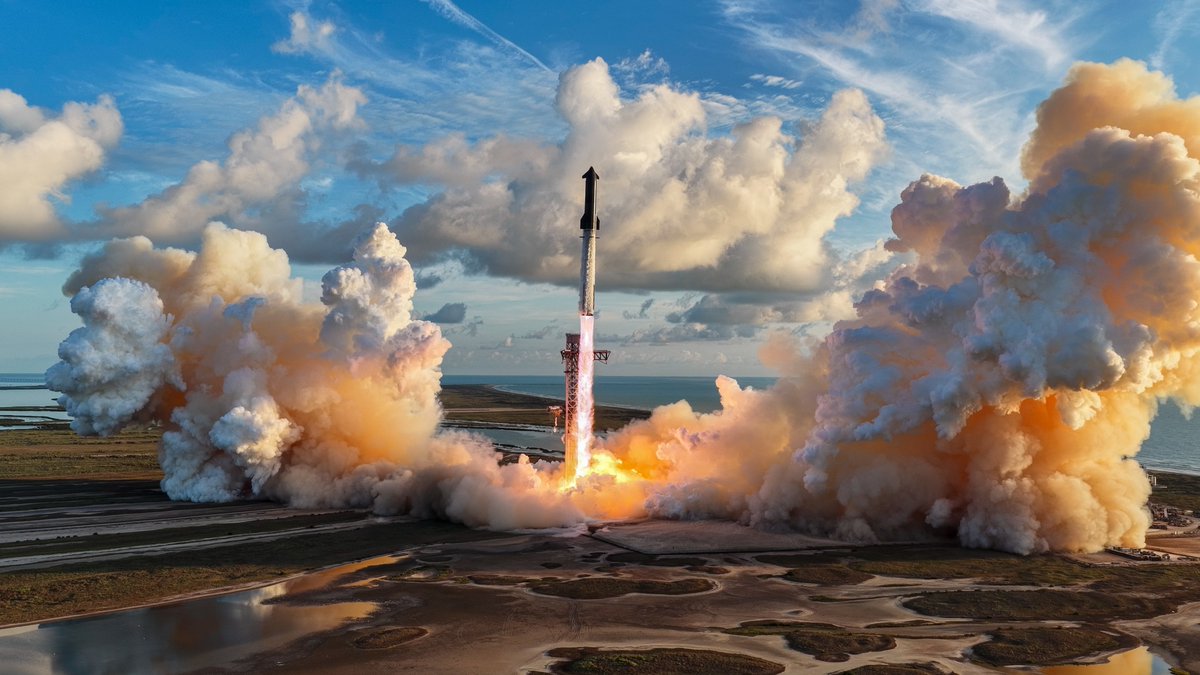
On a clear Monday morning along the Texas Gulf Coast, the world’s largest rocket finally did what it was built to do. At 7:46 a.m. Central Time, Starship and its Super Heavy booster lifted off from Starbase on Flight 14. Thirty-plus minutes later, mission control confirmed what no previous Starship flight had achieved: the vehicle was in orbit.
“Starship is orbital,” came the call. Cheers rose at Starbase. For the first time, the ship SpaceX had spent years refining completed an orbital insertion burn and began circling Earth.
First Operational Starlink V3 Deployment
This was more than a test. Flight 14 carried a real payload—26 next-generation Starlink V3 satellites—and successfully deployed every one of them. All 26 deployed on schedule, and SpaceX reported establishing contact with the satellites over laser links, ground stations, and Starlink user terminals. The satellites will now complete on-orbit checkouts and raise their orbits before beginning service.
That deployment marks Starship’s first operational mission and a meaningful addition of high-capacity bandwidth to the constellation. Each Starlink V3 satellite delivers roughly ten times the downlink capacity of the previous generation—about 1 terabit per second—along with dramatically higher uplink performance and denser beam coverage. A single full Starship load of these satellites can add roughly twenty times the network capacity of a Falcon 9 flight carrying V2 satellites.
Engine Anomaly and Early Deorbit
The day was not without drama. Shortly after stage separation, one of Starship’s Raptor engines shut down early. The ship compensated by burning its remaining engines longer and still reached the planned suborbital trajectory. Flight controllers then assessed the three sea-level Raptors needed for later burns, found them healthy, and gave a “go” for the orbital insertion burn. The ship lit a single sea-level engine and entered orbit.
Out of an abundance of caution after the ascent anomaly, the team later chose to limit time in orbit. Instead of the planned six orbits and nearly ten-hour flight, Starship performed its first-ever deorbit burn after roughly three hours and headed for a pre-cleared splashdown zone in the northern Pacific Ocean. The vehicle executed atmospheric reentry, a landing flip, and a controlled splashdown on target. After a successful boostback, the Super Heavy booster also completed its landing burn sequence and splashed down in the Gulf of Mexico.
Why Starship Orbit Matters
These results matter for reasons that reach beyond the launch pad. NASA selected Starship as the vehicle for the Artemis lunar lander. It is the platform that will eventually allow Starlink to scale capacity far more rapidly than Falcon 9 can. For families in rural areas, students, emergency responders, and communities still underserved by terrestrial broadband, that capacity expansion is not abstract. It is the difference between connection and isolation.
The path to this flight was, as we have come to expect from Spacex, iterative, . Thirteen previous integrated flights, most of them suborbital, taught SpaceX what worked and what needed fixing. Version 3 hardware had already flown twice. Flight 14 was the first to attempt sustained orbit and the first to carry revenue-generating satellites. The fact that the team could absorb an engine-out, still reach orbit, deploy the full payload, and return the ship under control demonstrates both the vehicle’s resilience and the maturity of the flight-control process.
What Comes Next for Starship
Challenges remain. Engine reliability during long burns and under ascent stresses still demands attention. Full rapid reusability—catching the booster and eventually the ship—has not yet been demonstrated. Those are the next mountains. But today’s flight cleared a fundamental one: Starship can reach orbit, deliver useful payload, and come home safely.
The work at Starbase continues a long American tradition of patient, disciplined engineering in service of ambitious ends. Reliable access to space strengthens national capability, expands economic opportunity, and extends the reach of tools that connect people. Flight 14 did not finish the story. It simply proved that the next chapters are now possible.
You can find official mission details and imagery on SpaceX’s website and X account. As always with developmental flights, the team will study the data carefully, and the next vehicle will incorporate what they learn. That iterative process—fly, learn, improve—is how lasting capability is built.