The Audacity
The Apollo Program — the most ambitious thing humanity has ever attempted, and the 400,000 people who made it happen
Part of Dare Mighty Things·Apollo
Part of the Dare Mighty Things series | Estimated read time: 6 minutes
Think about a number for a moment.
Four hundred thousand.
That's how many people — engineers, mathematicians, machinists, seamstresses, welders, programmers, flight controllers, physicians, janitors, cafeteria workers, secretaries, and scientists — were employed at the peak of the Apollo program. They worked at NASA centers and contractor facilities spread across 46 states. They built components in factories that had never made anything like them before, solved problems that had no existing solutions, and spent years — sometimes entire careers — contributing to a single mission that most of them would never witness from closer than a television screen.
Most of their names are not in any history book.
But on July 20, 1969, when Neil Armstrong stepped onto the surface of the Moon, every one of those 400,000 people had put something of themselves into the machine that carried him there. The spacesuit that kept him alive had been hand-stitched by workers in Delaware. Engineers in Massachusetts had programmed the guidance computer that navigated the descent. The rocket that launched him had been designed by a team in Alabama led by a man who had once built rockets for Nazi Germany.
Apollo was not the story of three astronauts. It was the story of what an entire civilization could do when it decided to stop arguing about whether something was possible and simply did it.
This is that story — the moments inside it that most people have never heard, and the ones that deserve to be told again.
What Kennedy Actually Said
On May 25, 1961 — three weeks after Alan Shepard's 15-minute suborbital hop and 44 days after Yuri Gagarin had become the first human in space — President John F. Kennedy stood before Congress and made a promise that almost nobody in the room believed was technically achievable.
"I believe that this nation should commit itself to achieving the goal, before this decade is out, of landing a man on the Moon and returning him safely to the Earth."
Nine years. They didn't have the rocket. They didn't have the spacecraft. They didn't have the navigation systems, the spacesuits, the communications infrastructure, or the launchpad. They didn't yet know how they would actually land on the Moon or get back off it. The entire American human spaceflight experience at that moment totaled 15 minutes and 22 seconds, none of it in orbit.
They did it in eight.
What happened between Kennedy's speech and the moment Armstrong's boot touched the lunar surface is the most compressed explosion of human engineering capability in history. Problems were solved that had never been attempted. Technologies were invented that did not exist. People worked with a focused urgency that has rarely been seen in peacetime, driven by the knowledge that the Soviets were working just as hard and that second place in this particular race meant something profound about the future of the world.
And underneath all of it, from the very beginning, was the understanding that people might die.
The Four Moments That Define Apollo
Apollo ran from 1961 to 1972, encompassing 17 missions, and put twelve human beings on the surface of another world. The stories inside it could fill a library. These are the ones that matter most — the ones that reveal what the program actually was, at its core.
The Fire That Almost Ended Everything
Apollo 1 | January 27, 1967
Eighteen months before the first Moon landing, three astronauts — Gus Grissom, Ed White, and Roger Chaffee — died in a launchpad fire during a pre-launch test. The program stopped. The spacecraft was taken apart. NASA spent 20 months rebuilding not just the capsule but itself.
What came out the other side was a different organization — more rigorous, more safety-conscious, and paradoxically more capable of reaching the Moon than the one that had existed before the fire. Apollo 1 was the disaster that made Apollo 11 possible—understanding why requires understanding what NASA found when it looked at itself honestly in the aftermath.
→ Read: The Fire — what happened on January 27, 1967, and what it cost to continue
The Mission Nobody Remembers
Apollo 8 | December 21–27, 1968
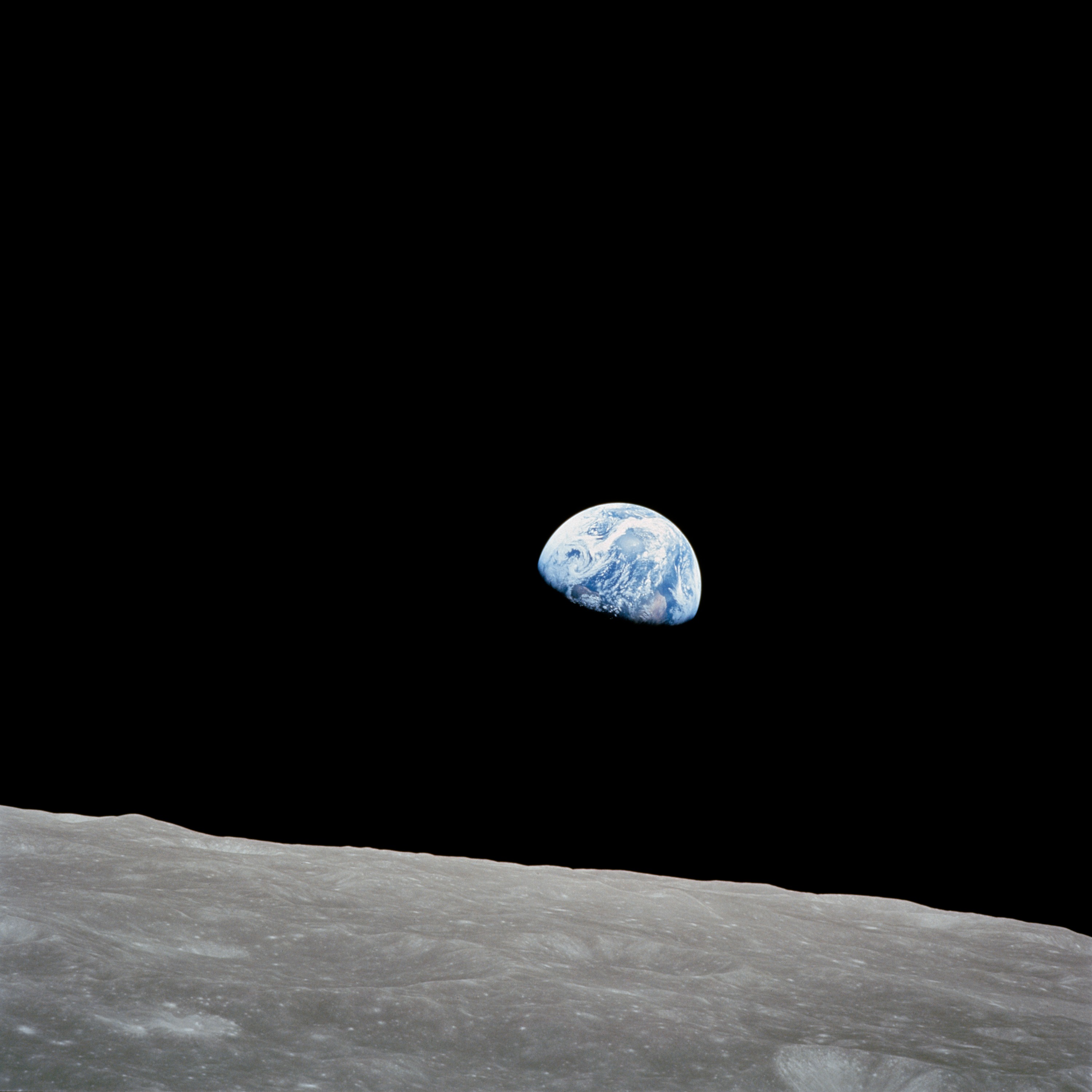
Seven months before the landing, three astronauts became the first human beings to leave Earth orbit, travel to the Moon, and orbit it. They did not land. They flew around it ten times on Christmas Eve, and one of them — Bill Anders — took a photograph that would become one of the most reproduced images in human history.
"Earthrise" — the Earth rising above the lunar surface, small and blue and utterly alone in the black — changed the way humanity saw itself. But what most people don't know is why NASA sent Apollo 8 to the Moon at all. The mission wasn't in the original plan. It was an improvised gamble, driven by intelligence reports about Soviet intentions, that required three astronauts to do something that had never been attempted with hardware that had barely been tested.
→ Read: Earthrise — the improvised gamble that sent humans to the Moon for the first time, and the photograph that came back with them
Thirteen Minutes
Apollo 11 | July 20, 1969
Everyone knows Armstrong's words. Fewer people know what happened in the thirteen minutes before he said them.
The powered descent to the lunar surface was the most dangerous phase of the entire Apollo program — a sequence of automated burns and manual corrections, conducted in near-total radio silence, with a computer that kept alarming and a landing zone that turned out to be a field of boulders. Armstrong had 30 seconds of fuel left when he finally put the Eagle down.
The Moon landing is usually told as a triumph. It was also, in those thirteen minutes, a series of things that nearly went catastrophically wrong — and a test of human judgment under pressure that still stands as one of the most remarkable moments in the history of flight.
→ Read: Thirteen Minutes — the powered descent nobody talks about, and the decisions that almost aborted the first Moon landing
The Last Footsteps
Apollo 17 | December 7–19, 1972
On December 14, 1972, astronaut Gene Cernan climbed the ladder of the lunar module Challenger, looked back at the Moon's surface one final time, and became the last human being to stand on another world. He has held that distinction for more than fifty years and counting.
Nobody informed the public that Apollo 17 was the last mission for the Apollo project. There was no formal announcement, no grand final ceremony. The program simply ended — budget cuts, shifting priorities, a public that had moved on. The final moments on the Moon were quiet, almost private, witnessed by a fraction of the audience that had watched Apollo 11. And the irony of it all is that the final mission was one of the most important, serving as the launch pad for the next great endeavor: the ISS.
What it meant to close that door, and what it has meant to leave it closed for half a century, is a question the program's final mission asks without fully answering.
→ Read: The Last Footsteps — what it meant to leave the Moon and never go back
More Apollo Stories
The four anchors above are the spine. These are the stories that fill in the rest of the picture.
[→ The Machine: The Saturn V] The most powerful rocket ever built — taller than the Statue of Liberty, louder than anything humans had created before it, and assembled by a team led by a man the American government had smuggled out of Germany after World War II.
[→ Earthrise: The Photograph That Changed Everything] A deeper look at the image Bill Anders took on Christmas Eve 1968 — what it showed, why it mattered, and how a single photograph from 240,000 miles away shifted the way humanity understood its own fragility.
[→ The 1202 Alarm] With 30 seconds of fuel remaining over the lunar surface, the guidance computer on Apollo 11 started throwing error codes nobody had seen in training. The 26-year-old engineer in Mission Control who knew what it meant — and the four seconds he had to decide whether to abort — is one of the most quietly extraordinary stories in the history of the space program.
[→ Gene Kranz and the Culture of Mission Control] The flight director who told his team after Apollo 1 that they were not blameless, and built the discipline that carried twelve men to the Moon and brought thirteen home alive from a crippled spacecraft.
[→ Neil, Buzz, and Michael] Three very different men, one mission, and what happened to each of them in the decades that followed. The psychology of being the first, the second, and the one who stayed in orbit.
What Apollo Actually Was
Here is what gets lost when Apollo becomes myth: it was hard. Not inspiring-hard, not movie-hard — genuinely, grinding, daily, we-don't-know-if-this-is-possible hard. People worked on it for years without knowing if it would succeed. Some of them didn't live to see whether it did. The problems they solved were real, and the failures were real, and the grief was real.
What makes Apollo extraordinary isn't that it was easy, or inevitable, or the product of genius that ordinary people can't relate to. What makes it extraordinary is that 400,000 ordinary people — most of them doing specific, limited, unglamorous work — collectively did something that had never been done, on a timeline that should have been impossible, driven by nothing more complicated than the conviction that it mattered.
That conviction didn't disappear when Apollo ended. It went somewhere. And now, fifty years later, it's building again — in a new generation of engineers, a new set of missions, and a new race to a Moon that still has no human footprints south of the equator.
The audacity that got us there the first time is exactly what's required to go back.
All the Apollo Stories
| Story | What It's About |
| The Fire | Apollo 1 and the disaster that rebuilt NASA |
| Earthrise | The improvised gamble of Apollo 8 and the photograph it brought home |
| Thirteen Minutes | The powered descent and the decisions that almost aborted the Moon landing |
| The Last Footsteps | Apollo 17 and what it meant to leave and never go back |
| The Machine | The Saturn V and the man who built it |
| The 1202 Alarm | The computer error with 30 seconds of fuel left |
| Gene Kranz | The flight director who built the culture that carried Apollo |
| Neil, Buzz, and Michael | Who they were, and what came after |
This hub is part of the Dare Mighty Things series. [← Back to the main series: Dare Mighty Things — The Story of America's Space Program]