The Last Footsteps
Apollo 17, December 1972 — humanity's last and most recent visit to another world
Part of Dare Mighty Things·Apollo
Part of the Dare Mighty Things series — Apollo | Estimated read time: 6 minutes
At 12:33 in the morning on December 7, 1972, the last Saturn V rocket lit up the Florida night.
There had been a two-hour-and-forty-minute delay — a hardware problem with a launch sequencer that had held the countdown just short of liftoff, leaving the crowd of half a million people at Kennedy Space Center waiting in the December darkness. When the hold finally cleared, and the count resumed, the anticipation had sharpened into something else. Nobody there had ever seen a Saturn V launch at night. Nobody anywhere had.
The five F-1 engines ignited at exactly 12:33 a.m. EST, and the effect was immediate and total. The darkness of the Space Coast gave way to noon. The Saturn V climbed on a column of fire that turned the Atlantic sky orange and lit the faces of everyone watching from miles away — families on highway shoulders, reporters on press stands, NASA workers who had seen dozens of launches and were not prepared for this one to be different. People a hundred miles away reported seeing it. The rocket climbed until it was a bright point moving against the stars, and then it was gone.
No Saturn V would ever launch again.
The Mission That Knew What It Was
By the time Apollo 17 launched, the Apollo program’s future had already been sealed. Budget pressures, NASA’s growing commitment to the Space Shuttle, and a public that had grown accustomed to Moon landings had led to the cancellation of missions 18, 19, and 20. The crew — Commander Gene Cernan, geologist Jack Schmitt, and Command Module Pilot Ron Evans — knew they were flying the final mission. So did everyone else connected to the program.
This gave the mission a quality none of the others had carried quite so explicitly: the awareness that what they were doing would not be repeated for a very long time, and possibly ever.
Gene Cernan had orbited the Moon before, on Apollo 10, descending to within eight nautical miles of the surface in the lunar module before pulling back — a dress rehearsal that brought him agonizingly close. He had spent years working toward a landing. When Apollo 17 was assigned to him, he understood what it meant and prepared accordingly. A naval aviator and electrical engineer who described himself as not the most naturally gifted person in any room he entered, he compensated with preparation, intensity, and an almost fierce sense of responsibility to the mission.
Jack Schmitt was different in almost every way — a professional geologist with a doctorate from Harvard, the first and only trained scientist to set foot on the Moon. He had been inserted into the crew over the objections of some at NASA who wanted a career pilot, because the scientific community had argued, persuasively, that sending twelve men to the Moon and returning them all without a geologist was a historic missed opportunity. Schmitt was irascible, opinionated, and extraordinarily good at his work. On the surface, his trained eye identified things a pilot-astronaut might have driven past.
The landing site they were given was the Taurus-Littrow valley — a narrow canyon on the eastern rim of the Sea of Serenity, flanked by massifs rising thousands of feet above the valley floor. Mission planners believed the site might harbor rocks both older and younger than those from previous missions, as well as evidence of ancient volcanic activity. It was arguably the most scientifically ambitious landing site of the program.
On December 11, Cernan and Schmitt brought the lunar module Challenger down into the valley. They would stay for three days.
Seventy-Five Hours
The work at Taurus-Littrow was relentless and extraordinary.
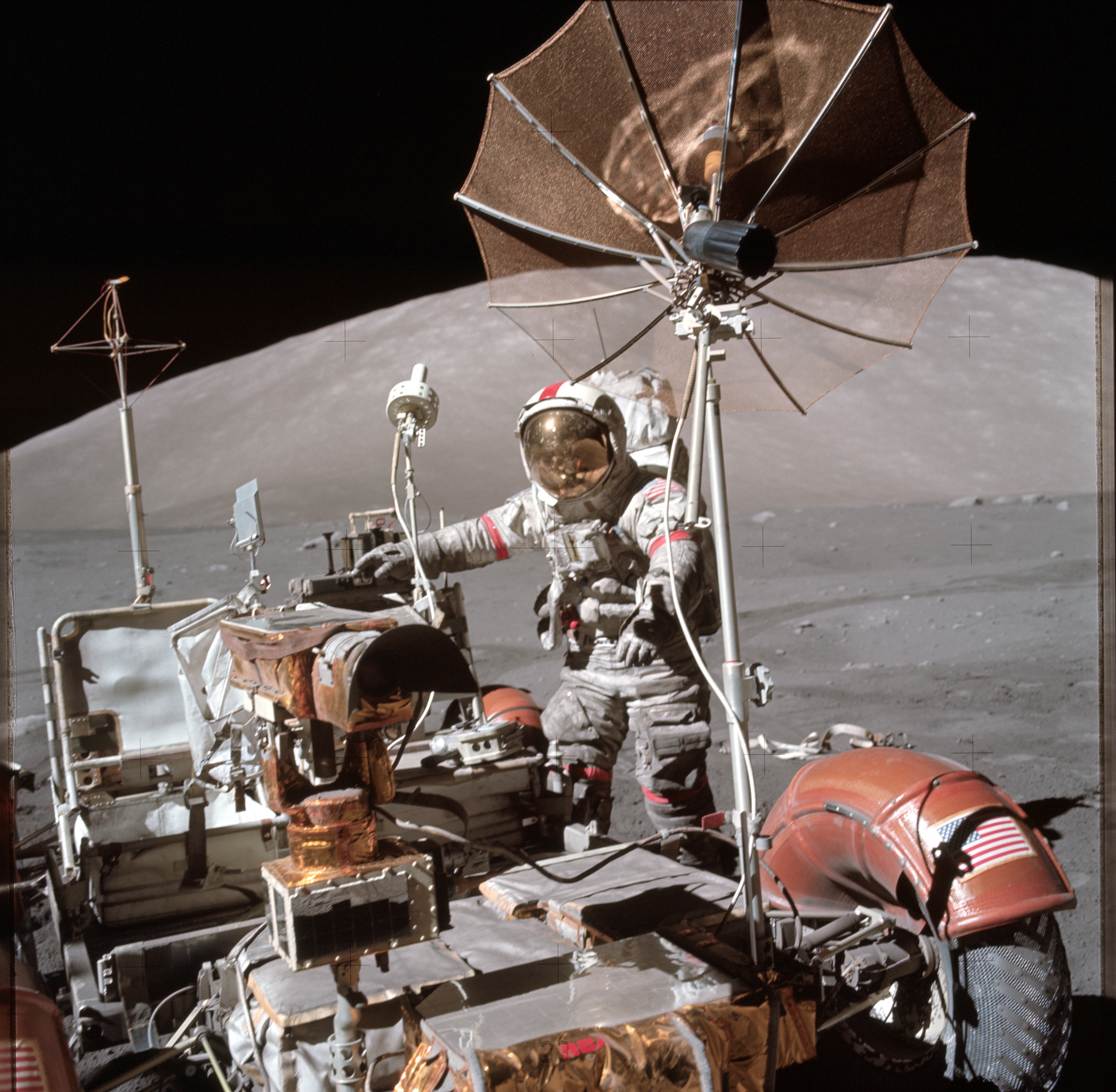
Cernan and Schmitt conducted three moonwalks totaling more than twenty-two hours — the longest EVA time of any Apollo mission. They drove the Lunar Roving Vehicle across the valley floor and up toward the base of the South Massif, covering thirty-five kilometers of terrain in total. On the second moonwalk, the longest in Apollo history at seven hours and thirty-seven minutes, they traveled to a point nearly eight kilometers from the lunar module — farther from safety than any Apollo crew had ventured before.
Schmitt, scanning the valley with the practiced eye of a field geologist, spotted something that stopped him cold: orange soil. Vivid, unmistakable against the gray of the regolith. Schmitt recognized it immediately as volcanic in origin — ancient pyroclastic glass beads from an eruption more than three billion years ago, preserved in the airless cold. It was the most scientifically significant geological discovery of the entire program.
On the way to the Moon, the crew had taken turns photographing the Earth as it receded from them, producing a series of images at increasing distances. One of those photographs — taken from about 28,000 miles, showing the full disk of the Earth with Africa centered and Antarctica visible at the bottom — became one of the most reproduced images in history. It was called "The Blue Marble." Where Earthrise from Apollo 8 had shown Earth as a fragile jewel suspended above a dead landscape, The Blue Marble showed it whole and alone in the void, a single complete world.
When Cernan and Schmitt finally finished their third and final moonwalk and began preparing Challenger for ascent, the weight of what they were doing was not lost on either of them. They had not slept well their final night on the surface. In the cramped cabin, in the strange silence of the Moon, they lay awake thinking about it.
The Initials in the Dust
Before climbing the ladder for the last time, Cernan drove the rover to a spot about a mile from the lunar module and parked it, configuring the television camera to film the liftoff. Then he climbed down and stood on the surface one final time.
He knelt and traced three letters in the gray dust.
T. D. C.
Tracy Dawn Cernan. His daughter, nine years old. She didn't know he'd done it until he came home. The initials will remain in the lunar soil for at least fifty thousand years — the Moon has no weather, no wind, no erosion beyond the occasional micrometeorite adding more dust. They will outlast anything her father ever built, said, or was remembered for on Earth.
Then he stood, put his boot on the ladder, and spoke the last words any human being has said while standing on another world.
"As I take man's last step from the surface back home for some time to come — but we believe not too long into the future — I'd like to just say what I believe history will record: that America's challenge of today has forged man's destiny of tomorrow. And, as we leave the Moon at Taurus-Littrow, we leave as we came, and, God willing, as we shall return, with peace and hope for all mankind. Godspeed the crew of Apollo 17."
He climbed the ladder. The hatch closed.
The ascent engine fired on December 14, 1972, at 5:54 in the evening. It was the last time a vehicle carrying human beings lifted off from a body other than Earth. Cernan and Schmitt left behind the descent stage of the Apollo Command Module, a plaque commemorating humanity's first exploration of the Moon, the rover, the scientific instruments, the tracks of their boots, and the letters in the dust.
What Came Next — And What Didn't
Cernan, Schmitt, and Evans splashed down in the Pacific on December 19. The debriefs began. The rocks were analyzed. The program that had consumed a decade, employed four hundred thousand people, and landed twelve human beings on another world quietly wound down.
The public reception was not what Apollo 11 had been. By Apollo 17, the Moon landings had become, to much of the world, routine — a word that says everything about the extraordinary thing that had happened to human perception in just three years. The same journey that had transfixed 530 million people in 1969 drew a fraction of that audience in 1972. Priorities had shifted. The Vietnam War was still grinding. Economic anxieties were mounting. The Space Shuttle promised something more practical, more reusable, more sustainable than heroic one-time leaps to the Moon.
But Apollo was not finished. One mission remained — not a Moon landing, but something arguably more consequential in its symbolism. Three years later, in July 1975, an American Apollo capsule would dock with a Soviet Soyuz spacecraft in orbit, and astronauts and cosmonauts would float through the hatch and shake hands, extending the brief peace of that moment across the chasm of the Cold War.
Apollo-Soyuz would be the true closing bracket of an era. For now, Apollo 17 was a pause — the most recent human footsteps on another world, preserved in dust that does not shift, waiting.
"Too many years have passed," Cernan said near the end of his life, "for me to still be the last man to have left his footprints on the Moon. I believe with all my heart that somewhere out there is a young boy or girl with indomitable will and courage who will lift that dubious distinction from my shoulders and take us back where we belong."
He was right about the years. He was right about the young person out there somewhere.
He died in January 2017, still the last man on the Moon.
Not for much longer.
This article is part of the Dare Mighty Things series — Apollo branch.
[→ Next in Apollo: Apollo-Soyuz — the handshake at the end of the era]
[← Back to Apollo: The Audacity — the full Apollo hub]
[← Back to the main series: Dare Mighty Things — The Story of America's Space Program]