Thirteen Minutes
The tense, improvised final descent — and how Neil Armstrong averted a near disaster.
Part of Dare Mighty Things·Apollo
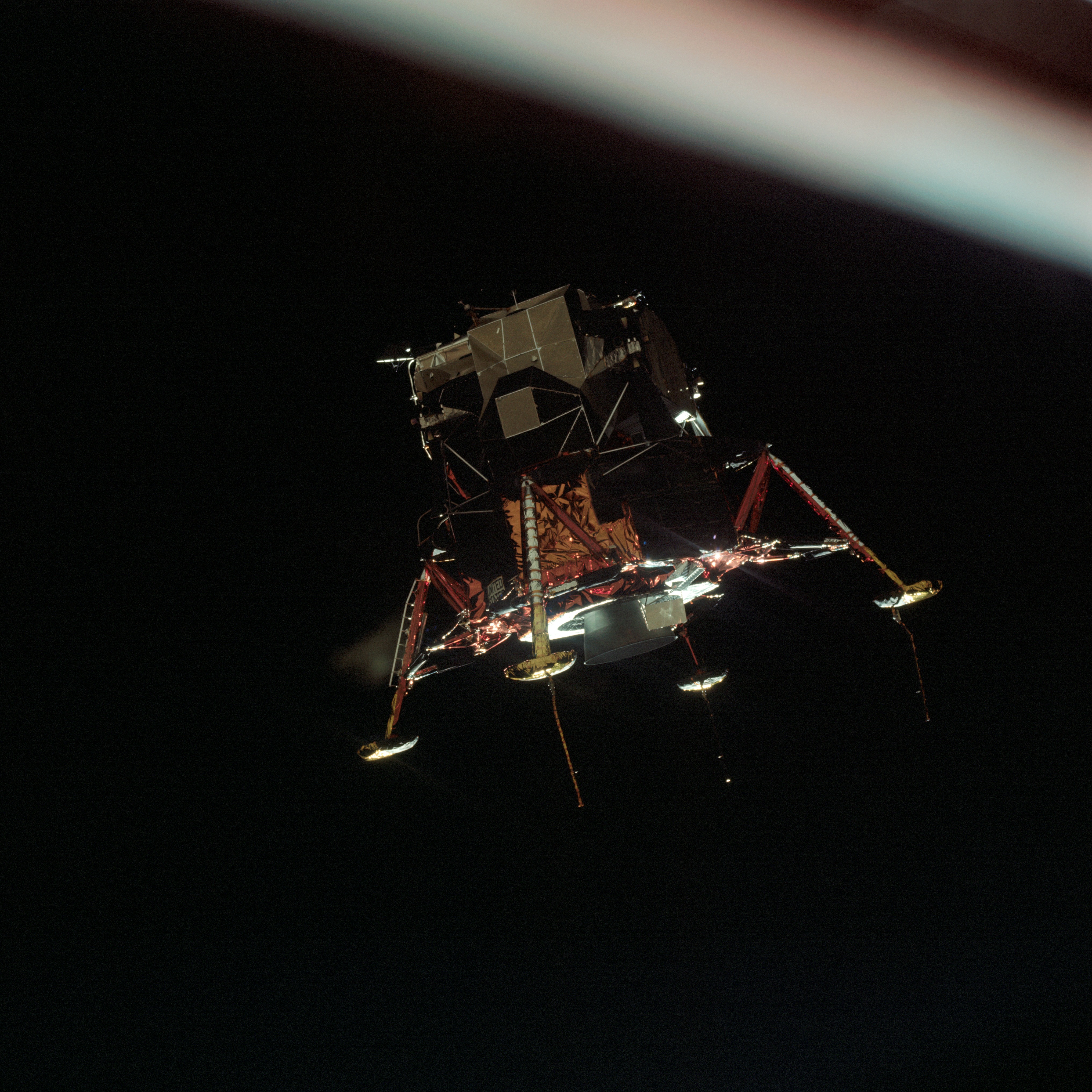
Everyone knows what Armstrong said when he landed. Almost nobody knows what happened in the thirteen minutes before he said it.
Part of the Dare Mighty Things series — Apollo | Estimated read time: 7 minutes
At 17,500 miles per hour, the Eagle separated from Columbia.
It was July 20, 1969 — a Sunday afternoon in Houston, late evening in most of Europe, the middle of the night in Australia. Neil Armstrong and Buzz Aldrin floated through the tunnel connecting the two spacecraft, pulled the hatch shut between them, and began running down the checklist that would take them to the Moon's surface.
Michael Collins remained alone in the command module as he watched the Lunar Module Eagle slowly drift away from his window. He had anticipated this separation for months and trained rigorously for it. Still, he would later reflect that in that moment he felt he was precisely where he was meant to be.
And then Columbia carried him around the far side of the Moon and every radio signal connecting him to the rest of humanity went silent.
The Moon was 2,160 miles wide. Collins was 60 miles above it, and the Moon itself stood between him and every other living person on Earth. No relay satellite. No radio bounce. Nothing. The silence was total and would return for 48 minutes on every one of his fourteen solo orbits.
"I am alone now," Collins wrote afterward. "Truly alone, and absolutely isolated from any known life. I am it. If a count were taken, the score would be three billion plus two over on the other side of the moon, and one plus God knows what on this side."
NASA's commentators, watching the telemetry and understanding what the silence meant, said: "Not since Adam has any human known such solitude as Mike Collins is experiencing during this 47 minutes of each lunar revolution."
Collins, for his part, said he was mostly thinking about the white mice. There was a colony of them back on Earth, part of the post-mission quarantine protocol, and if any of them got sick it could mean the crew had brought back a lunar pathogen. He worried about the mice. He felt fine otherwise.
The two halves of Apollo 11 flew on — one toward the most consequential thirteen minutes in the history of human exploration, one alone in a silence no person had ever experienced before.
What Powered Descent Actually Was
Here is what the history books leave out: the Moon landing was not a controlled descent. It was a controlled fall.
The Eagle began powered descent initiation at an altitude of roughly 50,000 feet above the lunar surface, traveling at orbital velocity — nearly 3,500 miles per hour. The descent engine fired directly against that velocity, burning 18,000 pounds of propellant over twelve and a half minutes to bleed off the speed while simultaneously managing the trajectory toward the landing zone. The computer calculated a curved path that would reduce both altitude and horizontal velocity to zero simultaneously, ideally over a flat, safe patch of the Sea of Tranquility.
At the start of powered descent, the Eagle was flying face-down — windows pointing at the surface — so the landing radar could lock onto the terrain below. Armstrong and Aldrin could see nothing but the Moon beneath them. They were navigating entirely on instruments, trusting a guidance computer with 4 kilobytes of memory to do the hardest part of the most important flight in history.
Four minutes into the descent, at 38,000 feet, Aldrin called out: "Program alarm."
The number on the display was 1202.
Armstrong had never seen it in training, and neither had Aldrin. Neither had most of the people in Mission Control.
Twenty-Six Years Old and Four Seconds
In Mission Control in Houston, at a console in the back of the room, sat a 26-year-old MIT engineer named Jack Garman. He had spent the months before the mission doing something that turned out to be extraordinarily prescient: compiling a list of every possible computer alarm code and what each one meant, then memorizing which ones were safe to fly through and which ones were abort conditions.
The 1202 alarm was an executive overflow error. The guidance computer was telling them it was taking on more tasks than it could process simultaneously and was shedding lower-priority functions to keep the critical ones running. The question — which had to be answered in seconds — was whether the shed functions included anything that mattered for the landing.
Garman knew the answer. The 1202 was a "go" alarm. As long as it wasn't occurring continuously, the computer was managing the overload and the landing could continue.
Charlie Duke, the Capcom — the only voice in Mission Control that spoke directly to the crew — heard Garman relay the word to Flight Director Gene Kranz. Kranz gave the call. Duke pressed his microphone.
"We're go on that alarm," he said.
Armstrong and Aldrin continued their descent. Four more alarms fired before they touched down. Each time, Garman confirmed go. Each time, Duke relayed it. The computer was stressed but functional — handling the overload by prioritizing guidance over housekeeping tasks, exactly the way it had been designed to do.
The 1202 alarm had never been seen in simulation. It appeared five times in the final minutes of humanity's first lunar landing. The program that had triggered it — a rendezvous radar that should have been switched off but wasn't — had been left running, flooding the computer with data it didn't need.
The landing almost aborted before anyone saw the boulder field.
The Crater
At 2,000 feet, Armstrong looked out the window and felt his stomach drop.
As the computer guided them toward West Crater — a crater the size of a football stadium littered with car-sized boulders — Armstrong realized this was not where he wanted to attempt the first landing. He would later describe the site in exactly those terms.
Armstrong took manual control.
He began flying the Eagle horizontally, sliding across the surface at low altitude, searching for a clear patch of ground beyond the crater. The descent engine was burning fuel the entire time — fuel that had been calculated precisely for the planned trajectory, not for an extended sideways search over a boulder field at 100 feet of altitude.
"Sixty seconds," Duke called from Houston.
Sixty seconds of fuel remaining.
Armstrong kept flying. The terrain below him was still rocky. He was covering horizontal ground at roughly 50 feet per second, the dust from the descent engine now obscuring the surface in clouds that made it increasingly difficult to see what he was landing on. He could gauge his altitude from the shadow of the Eagle on the ground below. He was moving. He was descending. He was running out of time.
"Thirty seconds."
Aldrin called out altitude and descent rate, precise and steady, reading the instruments while Armstrong flew by sight. "Drifting right. Contact light."
The contact light meant one of the four probes extending from the landing legs had touched the surface.
Armstrong cut the engine.
The Eagle dropped the last few feet and settled onto the Moon.
The Words Nobody Hears
The room in Houston erupted — controllers grabbing each other, some crying, Duke so flustered he stumbled over his own response. The world would hear Armstrong's "Houston, Tranquility Base here — the Eagle has landed" replayed thousands of times over the following decades.
What the replays always cut away from is what happened in the next thirty seconds inside the spacecraft.
Armstrong and Aldrin were running their engine shutdown checklist. Armstrong had landed with somewhere between seventeen and thirty seconds of fuel remaining — estimates varied based on what qualified as usable propellant. The difference between landing and not landing had been measured in a heartbeat. They had just done the hardest thing any human crew had ever been asked to do in a spacecraft, in real time, with no chance to rehearse it.
Aldrin looked at Armstrong.
"We missed the PDI point by about 1,100 feet," Aldrin said — a technical observation about where they had actually touched down versus where the computer had been aiming.
"Okay," said Armstrong.
That was it. No celebration. No exhale into the mic. They were still on the checklist. They had seventeen hours on the surface, and an ascent engine that had to work perfectly or they were not coming home, and there was a procedure to follow, and they followed it.
The restraint in those thirty seconds is more revealing about who Neil Armstrong was than anything he said when he stepped onto the surface six hours later.
Three Billion Plus Two
Above them, in Columbia, Michael Collins heard Duke's transmission cut through the static: "Eagle, Houston. We copy you down." And then Armstrong's voice: "Tranquility Base here. The Eagle has landed."
Collins was not, at that moment, on the far side of the Moon. He had been waiting for this. He had heard the alarms, heard the fuel callouts, heard the thirty seconds. His response, when he was able to transmit, was characteristically spare: "Beautiful. Just beautiful."
He flew his orbits. He ran his systems checks. He photographed the surface below him, searching for the speck that was the Eagle somewhere in the Sea of Tranquility, unable to find it in the vast gray plain. He was not lonely. He was not afraid. He was part of something structured for three men, and he considered his third as necessary as either of the other two.
When Armstrong and Aldrin finally lifted off the next day, Collins maneuvered Columbia to meet them. The ascent engine — which had only one chance to fire, with no backup — worked. The rendezvous was flawless. The hatch opened. Armstrong and Aldrin floated back through.
"Not since Adam has any human known such solitude," NASA's commentators had said of Collins. The commentators offered the line as a poignant observation, meant to evoke the singular solitude Collins faced while the rest of humanity waited on the other side of the Moon. In doing so, they touched on something deeper than technical achievement—the strange, almost biblical loneliness of being the only human being out of reach.
Collins thought it was slightly overstated. But he had been there, and they hadn't.
What the Thirteen Minutes Were
The Moon landing is usually told as a moment — the boot on the soil, the words, the flag, the photograph. All of that happened. All of it matters.
But the landing itself — the thirteen minutes of powered descent — was something different. It was a sequence of compounding problems solved in real time by people who had prepared for almost everything and were now dealing with the rest. A computer alarm nobody had seen in training—a boulder field where the landing zone was supposed to be. A fuel counter ticking down while a man flew a spacecraft sideways over rocks trying to find a patch of flat ground.
Every element of it — the alarm, the manual control, the fuel — was its own near-miss. Any one of them going the wrong way would have ended in an abort, or worse. All three happened at once, and the mission continued.
That is what Armstrong meant when, after landing, he described it as being like a test pilot's flight — tense, demanding, requiring judgment, improvisation, and an ability to work the problem without letting the problem work you.
The words he said when he got out of the Eagle six hours later are famous for a reason.
What he did to get there is the part that earns them.
This article is part of the Dare Mighty Things series — Apollo branch.
[→ Next in Apollo: The Last Footsteps — what it meant to leave the Moon and never go back]
[← Back to Apollo: The Audacity — the full Apollo hub]
[← Back to the main series: Dare Mighty Things — The Story of America's Space Program]